

HRMS & HCM Development & Integration
An HRMS that fits how your organisation actually runs HR.
LasMind builds custom HRMS applications around your policies and approval chains, and integrates them with payroll, ERP, biometric, and accounting systems — delivered through teams in India.
- Custom HRMS builds
- Payroll engine
- Biometric integration
- Statutory compliance
- India delivery
By the numbers
Owned systems payroll teams can trust.
200+
Clients served
98%
Client retention
Zero
Per-employee licensing on custom builds
100%
Code and data ownership
What these services are
Encode your HR rules. Make them run everywhere.
Custom HRMS development creates an asset you own. HRMS integration keeps attendance, payroll, and statutory reporting flowing without re-keying.

HRMS software development
Designing and building an HR application around your organisation’s specific policies, org structure, and approval chains — covering employee records, attendance, leave, payroll, recruitment, performance, and compliance. Unlike a SaaS HRMS, a custom-built system is an asset you own, with no per-employee licence that grows every time you hire.
HRMS integration
Connecting your HR system to the other systems that carry employee and payroll data — biometric devices, accounting platforms, ERP, banking APIs, and communication tools — so attendance, payroll, and statutory reporting flow without manual re-keying. Development encodes your HR rules correctly; integration makes those rules execute across every system that touches an employee’s record.

Why LasMind
Built for complex policies, integrations, and Indian statutory reality.
Custom fit for complex HR policies
SaaS HRMS products handle standard policies well. They struggle when your payroll has variable production incentives, shift premiums that differ by plant, multi-entity leave rules, or approval chains that follow reporting lines plus a second approver for specific roles. LasMind builds the system around those rules — not the other way around.
Integration is designed in
Most HRMS failures are integration failures: biometric punches that never reach payroll, salary journals re-keyed into Tally, or employee master changes that don’t propagate to the ERP. LasMind defines API contracts, webhook strategies, and device integration points before development begins.
Full ownership, no per-employee fees
You own 100% of the code, database schema, and data model. A custom HRMS has no per-employee licence — scaling from 100 to 1,000 employees does not multiply your software bill. Your employee data stays on infrastructure you control or specify.
Built for statutory reality
LasMind builds HRMS systems with PF/EPF, ESI, state-wise professional tax, TDS, LWF, gratuity, and bonus calculations as native modules — not third-party add-ons that lag behind statutory changes. We also build with DPDP Act 2023 requirements in mind, including audit logs, role-based access, and consent-aware data handling.
HRMS software development
Build, customise, migrate, or add AI — around your employee lifecycle.
From greenfield HRMS to extending Keka, Darwinbox, greytHR, Zoho People, or SuccessFactors, we shape the system around how your HR and payroll teams actually work.
Custom HRMS application development
Build an HRMS from the ground up around your employee lifecycle — core HR records, onboarding, attendance, leave, payroll, performance, and exits. Modules are designed around your org chart, grade structures, and approval workflows.
HRMS customisation and module extension
Extend existing HRMS platforms (Keka, Darwinbox, greytHR, Zoho People, SAP SuccessFactors) with custom modules, payroll rules, and reporting logic that the platform’s native configuration cannot handle.
Payroll engine development
Build custom payroll engines with your exact earnings and deductions structure, variable pay, shift allowances, arrears, full-and-final settlement, and statutory computation. This is the module where SaaS workarounds most often break down.
HRMS migration and modernisation
Migrate from spreadsheets, legacy HR tools, or end-of-life platforms to a modern HRMS. LasMind handles employee master migration, historical payroll data mapping, document vault transfer, and parallel-run validation — without disrupting a live payroll cycle.
Employee self-service and mobile HR apps
Build web and mobile ESS portals for payslip download, leave application, claims, IT declarations, and attendance regularisation. WhatsApp and Microsoft Teams chatbots can be layered on for common HR queries.
AI-enabled HR features
Add attendance anomaly detection, attrition risk scoring, AI-assisted resume screening, and HR query chatbots — built on your own data model rather than a vendor’s fixed roadmap.
HRMS integration
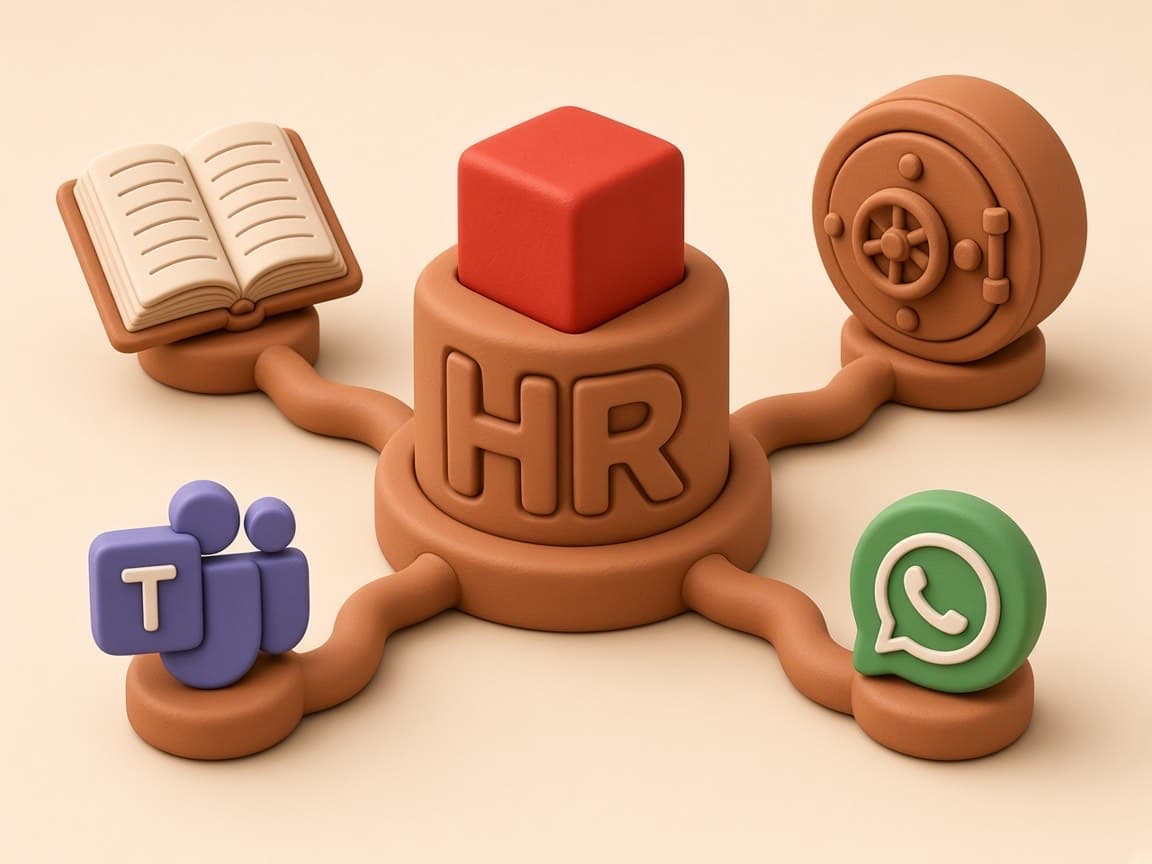
Connect biometrics, accounting, ERP, banking, and chat without gaps.
Punches reach payroll, journals post after close, and every conversation lands on the right employee record.
Biometric and attendance device integration
Connect devices so punches flow into HRMS and payroll without CSV exports. Integration can be device-SDK-based, REST API-based, or middleware-driven, depending on the hardware.
Payroll-to-accounting integration
Sync payroll journals into Tally Prime, SAP, Oracle, Zoho Books, and Microsoft Dynamics. Attendance and payroll must close before journal vouchers can post — LasMind builds the integration so that sequence executes automatically rather than through manual imports.
ERP and enterprise system integration
Connect HRMS with SAP S/4HANA, Oracle HCM, Microsoft Dynamics, and custom ERP systems for employee master sync, cost-centre allocation, and headcount reporting. Where native connectors fall short, LasMind deploys middleware such as SAP CPI, Dell Boomi, or MuleSoft.
Banking and salary disbursement integration
Integrate banking APIs and payment files for salary disbursement, reimbursements, and statutory payments — with reconciliation status written back to the HRMS.
Communication and collaboration integration
Connect HRMS with Slack, Microsoft Teams, WhatsApp Business API, and email for approval notifications, payslip delivery, policy announcements, and chatbot-based HR support.
API development and middleware
Build RESTful APIs and webhook-based event flows for systems that lack native connectors. LasMind supports real-time push, scheduled sync, and batch integration patterns based on latency requirements.
How it works
From policy discovery to go-live in four steps.

HR policy and workflow discovery
We document your payroll rules, leave policies, approval hierarchies, statutory requirements, and integration landscape (2–4 weeks).
Architecture and compliance design
Data model, payroll calculation logic, API contracts, and device integration strategy are finalised before development.
Build, integrate and parallel run
Development proceeds in agile sprints. Payroll and attendance integrations are tested against live sandbox data, and a parallel payroll run is executed before cutover.
Go-live and support
Deployment with user training, hypercare through the first payroll cycle, and an ongoing SLA-backed maintenance agreement.
Proof in practice
Parallel payroll without a manual journal entry.
Client snapshot
A multi-plant manufacturing client engaged LasMind to replace a spreadsheet-driven payroll process with a custom HRMS. The system eliminated six separate CSV exports per payroll cycle, enabled plant-specific shift premiums and production incentives to calculate natively, and completed the first parallel payroll run without a single manual journal entry.
FAQ
Frequently asked questions
Common questions about custom HRMS and HCM development. If yours isn't here, ask us directly.
Is a custom HRMS better than Keka, Darwinbox, or GreytHR?
It depends on policy complexity and integration depth. SaaS HRMS products are faster to deploy and handle standard policies well for smaller teams. Custom HRMS development wins when your payroll rules cannot be reproduced in a vendor demo without a spreadsheet beside it, when you run multiple legal entities with different leave and allowance structures, or when employee data must reside on infrastructure you control.
Can you customise or extend an existing HRMS instead of building from scratch?
Yes. LasMind provides customisation services for Keka, Darwinbox, greytHR, Zoho People, and SAP SuccessFactors — building custom modules, payroll rules, and reporting logic where native configuration falls short. We help you extend what fits and build custom components where it does not.
What is the difference between HRMS and HCM?
HRMS typically refers to the operational core — employee records, attendance, leave, payroll, and compliance. HCM (Human Capital Management) is a broader category that includes talent management, performance, learning, and workforce analytics. LasMind builds both, with the scope determined during discovery.
How long does it take to build a custom HRMS?
A core HRMS covering employee records, attendance, leave, and payroll typically takes 8–16 weeks for a focused scope. A full-suite HRMS with recruitment, performance, ESS mobile apps, and multiple integrations can take 4–8 months. LasMind’s discovery phase produces a detailed module-by-module timeline before development begins.
Can you integrate biometric devices from ZKTeco, eSSL, or Matrix?
Yes. LasMind integrates all major biometric brands through device SDKs, REST APIs, or middleware. Attendance punches can be pushed to HRMS in real time via webhooks, or pulled on a schedule depending on device capability and network architecture.
How do you handle payroll-to-Tally or payroll-to-SAP integration?
LasMind builds payroll-to-accounting integrations that map salary components to the correct ledger heads and post journal vouchers automatically after each payroll cycle. For Tally, this typically uses XML or ODBC-based integration; for SAP and Oracle, we use native connectors or middleware such as SAP CPI or Dell Boomi where required.
Do I own the code and the employee data?
Yes — 100%. All code, database schemas, and documentation are assigned to you under the master services agreement. Employee data remains yours and is hosted on infrastructure you control or specify. LasMind claims no ownership or reuse rights over client-specific deliverables.
How do you handle DPDP Act compliance and data security?
LasMind builds HRMS systems with role-based access control, audit logs, encryption at rest and in transit, and consent-aware data handling aligned to India’s DPDP Act 2023. HRMS platforms holding employee financial and medical data are subject to deeper security scrutiny, and LasMind supports third-party penetration testing and security audits where required.
What happens during a payroll parallel run?
Before go-live, LasMind runs the new HRMS payroll engine in parallel with your existing process for one or more cycles. Outputs are compared line by line — gross, deductions, statutory contributions, and net pay. Discrepancies are resolved before cutover, so the first live payroll cycle carries no surprises.
Can the HRMS work on mobile for field and remote staff?
Yes. LasMind builds Employee Self-Service (ESS) mobile apps with offline attendance capture, GPS/geo-fenced check-ins, payslip download, leave application, and approval workflows. Field staff can punch attendance without a smartphone via SMS or kiosk-based alternatives where required.
What support is available after go-live?
LasMind provides SLA-backed maintenance covering statutory updates, bug fixes, security patches, and minor enhancements. Statutory maintenance is particularly important for HRMS — PF, ESI, and professional tax rules change, and the system must be updated without disrupting payroll.
Ready to build an HRMS that fits your organisation?
Join 200+ businesses using LasMind to build, customise, and integrate HR systems that payroll teams trust.
Get a free estimate
Tell us about your project
Share your email and mobile number with a few lines about your hrms development needs. We reply within one business day.